
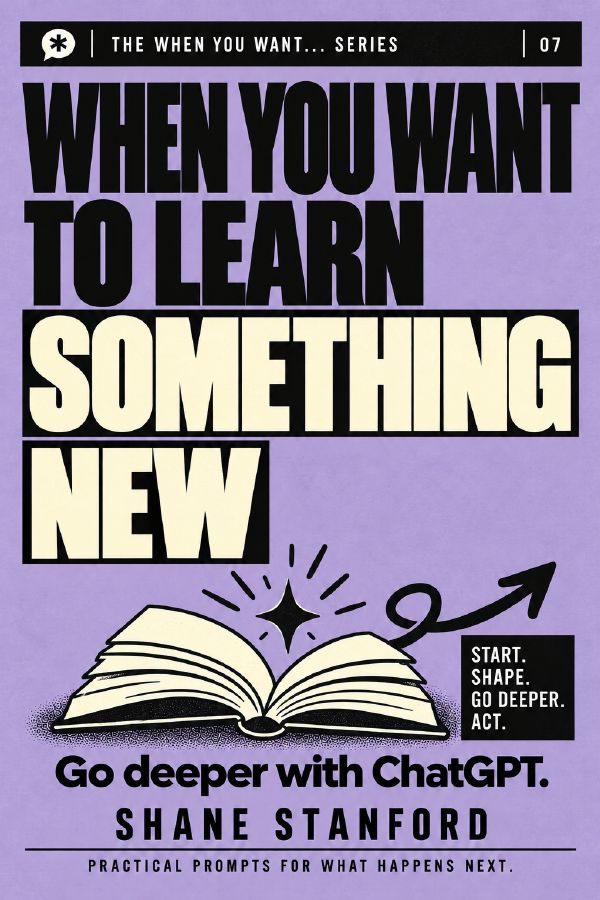
When You Want · Volume 07 · Printed companion
When You Want to Learn Something New
You are in the right place. This is the companion page printed in the book: whenseries.com/companion/want-07/.
For courses you have saved and not started, explanations that slip when you try to use them, and learning that has to fit the life you already have. The useful question is what you want to be able to do.
Use the prompt in the book
Choose a chapter and a prompt title that fit today. The numbers on this page match the book.
Type the starting prompt into a text chat. Replace the square brackets with your own context. Leave out names, identifying details and private documents.
Choose a follow-up, correct an assumption, or ask for a smaller step. Stop when the conversation has done enough.
Lines worth keeping nearby:
- Ask me one question at a time.
- That is too general. Use the details I have given you.
- You are assuming something I have not said. Check with me first.
The book is complete on its own. All 64 conversations, follow-ups and stopping points are in the printed pages. This public page helps you use them. It does not stand in for the book.
Chapters in this book
- 01Choose something worth learning
- 02Find material that serves your goal
- 03Make sense of difficult ideas
- 04Practise with a clear purpose
- 05Remember what you need and return
- 06Use what you are learning
- 07Work with the obstacles in front of you
- 08Choose what comes next
Keep the choices yours
An explanation can sound clear and still be wrong. Check anything important against a reliable source, and leave what does not fit.
These exercises support reflection and practical planning. They do not provide diagnosis, therapy, or individual legal, financial or medical advice. An AI can misunderstand, invent details or agree too readily. You can reject its suggestions. If there is immediate danger, or you feel unable to keep yourself safe, contact your local emergency or health service. In the UK, call 999 in an emergency. A prompt is not emergency support.
Public sources
These are independent organisations. They are not part of the When series, and a page here is not personal advice.
- OpenLearn
Free learning from The Open University. Check any explanation you rely on.
Text and artwork were developed with AI assistance. Editorial responsibility remains with Shane Stanford. The series is independently produced and is not affiliated with or endorsed by OpenAI.